Can You Remove Stitches at Home Yourself?
The short answer is no — not because it is difficult, but because the judgement calls around it are the part that matters. Here is what a trained pair of hands is actually checking.
 homenurse.sg
General information, not a substitute for personal medical advice. For urgent symptoms, call 995.
The short answer
You should not take your own stitches out, and you should not have a family member do it either. Not because pulling a suture is hard — it is not — but because almost everything that goes wrong with stitch removal happens before or after the cutting, in judgement calls that are difficult to make on yourself.
This page explains what those judgement calls are. If you read it and still want to go ahead, at least you will know what you are deciding. And if you would rather someone did it properly, a nurse visit for body-site stitches and staples is on our stitch and staple removal page.
What actually goes wrong
- The wound was not ready, and it opens once the support is gone — the commonest problem, and the hardest to judge on your own body
- A stitch is cut in the wrong place, so a length of dirty external thread is dragged back through the skin
- Part of a suture is left behind, which the body then walls off and inflames weeks later
- An infection that was already starting gets missed, because a wound that is quietly infected does not always look dramatic
- The stitches were never meant to come out — some are absorbable, and some cosmetic sutures are deliberately left in place
Is the wound even ready?
This is the first question and the one people get wrong. A date on a discharge sheet is a guide, not an instruction. What matters is whether the wound edges have knitted enough to hold without support — and whether that is true along the whole length, not just the ends, which is exactly what is hard to assess on your own abdomen or the back of your own arm.
If the wound is not ready, the answer is not to pull them out anyway on schedule. It is a conversation with the doctor who put them in.
What good care looks like
Good home nursing is more than completing a task. For stitch and staple removal, it means a trained nurse who works cleanly and gently, checks how the patient is doing, keeps the family informed, and writes down what they found so the patient's doctor stays in the loop. The best sign of good care is that nothing is a surprise — the family knows what was done, what to watch for, and when the next visit is.
What a proper removal looks like
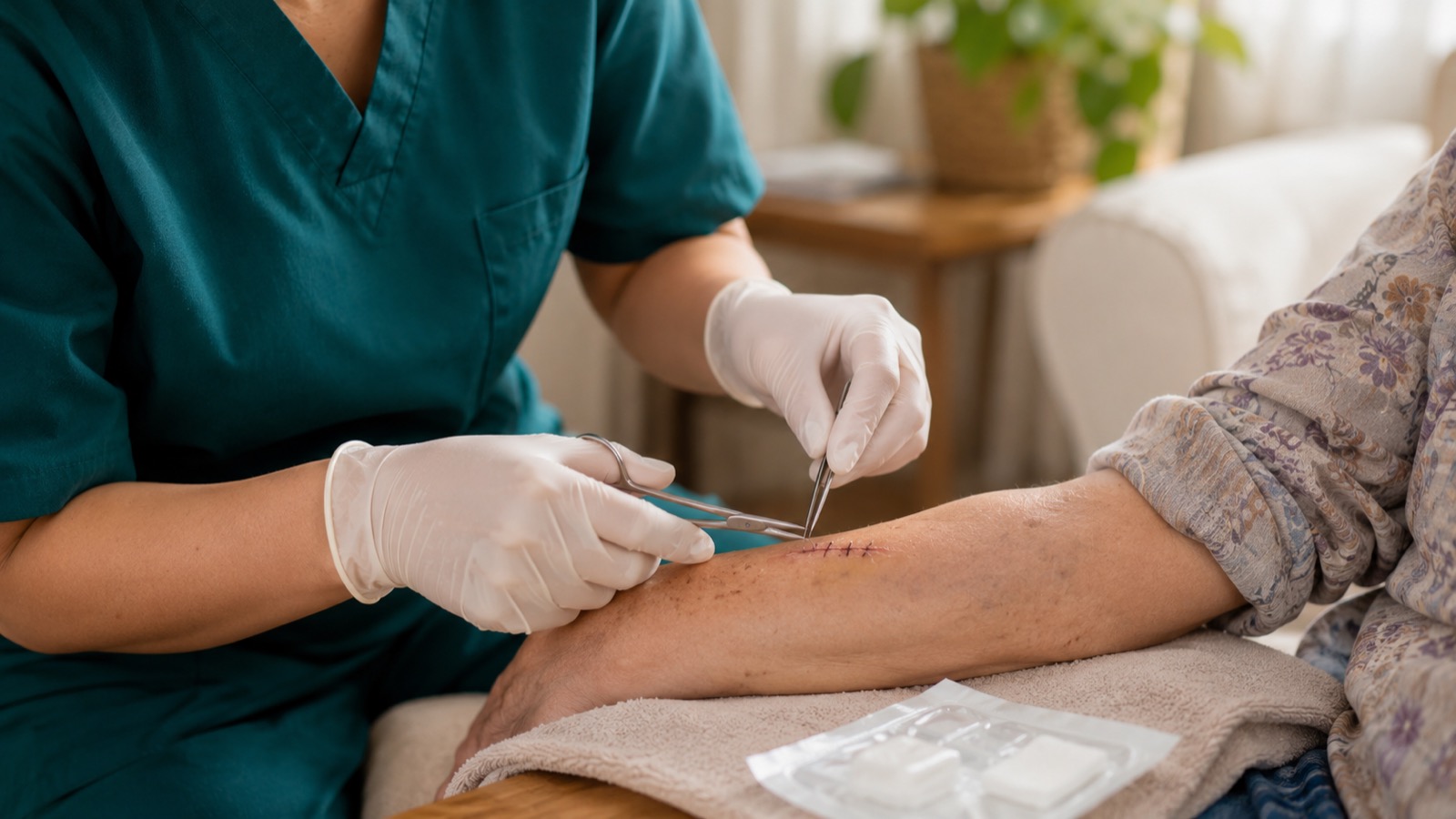
Clean field, clean hands, good light. Each stitch is lifted and cut so that no part which was sitting outside the skin is pulled back through it, and they come out one at a time, with the wound checked as it goes rather than at the end. If the wound starts to gape, removal stops there.
Afterwards the site is cleaned and redressed if it needs it, and you get the boring but useful advice: keep the scar clean, keep it out of the sun — which matters more in Singapore than most places — and moisturise it as it matures.
Who can remove stitches in Singapore
For stitches and staples on the body after general, orthopaedic, obstetric or day surgery, a registered nurse can do it, including at home. That covers abdominal and limb wounds, surgical staples and drain sites.
For anything cosmetic or aesthetic — facial work, eyelid surgery, rhinoplasty — it is a doctor in a clinic, not a nurse at home. The reasoning and the clinics we would suggest are set out on our stitch and staple removal page. If your surgery was done overseas, our guide to stitch removal after surgery abroad covers the timing and who to see.
When to get seen rather than wait
Whoever ends up removing them, get the wound looked at the same day if:
- The wound opens or gapes after the stitches come out
- Redness is spreading out from the wound, or the skin feels hot
- There is discharge or pus, or a smell
- There is fever, or the wound is getting more painful instead of less
- You think a fragment of stitch has been left behind
Common questions
Can I remove my own stitches at home?
You should not. The cutting is the easy part; judging whether the wound has healed enough to hold without support is not, and it is particularly hard to judge on your own body. Getting it wrong means the wound opens, or a fragment is left behind, or an early infection is missed. A registered nurse can remove body-site stitches and staples at home instead.
Can a nurse take stitches out, or does it have to be a doctor?
For stitches and staples on the body after general, orthopaedic, obstetric or day surgery, a registered nurse can remove them — that is routine nursing practice in Singapore. Cosmetic and aesthetic sutures, particularly facial and eyelid work, are a doctor's job in a clinic.
How do you know when stitches are ready to come out?
By looking at the wound rather than the calendar. The edges need to have knitted along the whole length, not just at the ends. The timing your surgeon gave you is the guide, but a wound that is not ready at day ten is not ready, and the stitches should stay until a clinician says otherwise.
What happens if stitches are left in too long?
The skin starts to grow around the suture material, which makes removal harder and can leave small permanent marks either side of the scar — the so-called railway-track appearance. That is why the timing matters in both directions, not just early.
Do absorbable stitches need removing?
No, they dissolve on their own. But not every stitch that looks absorbable is one, and some wounds are closed with a mix. Check the operation note or discharge sheet rather than assuming, and if it does not say, ask rather than pull.