Male Urinary Catheter Change at Home in Singapore
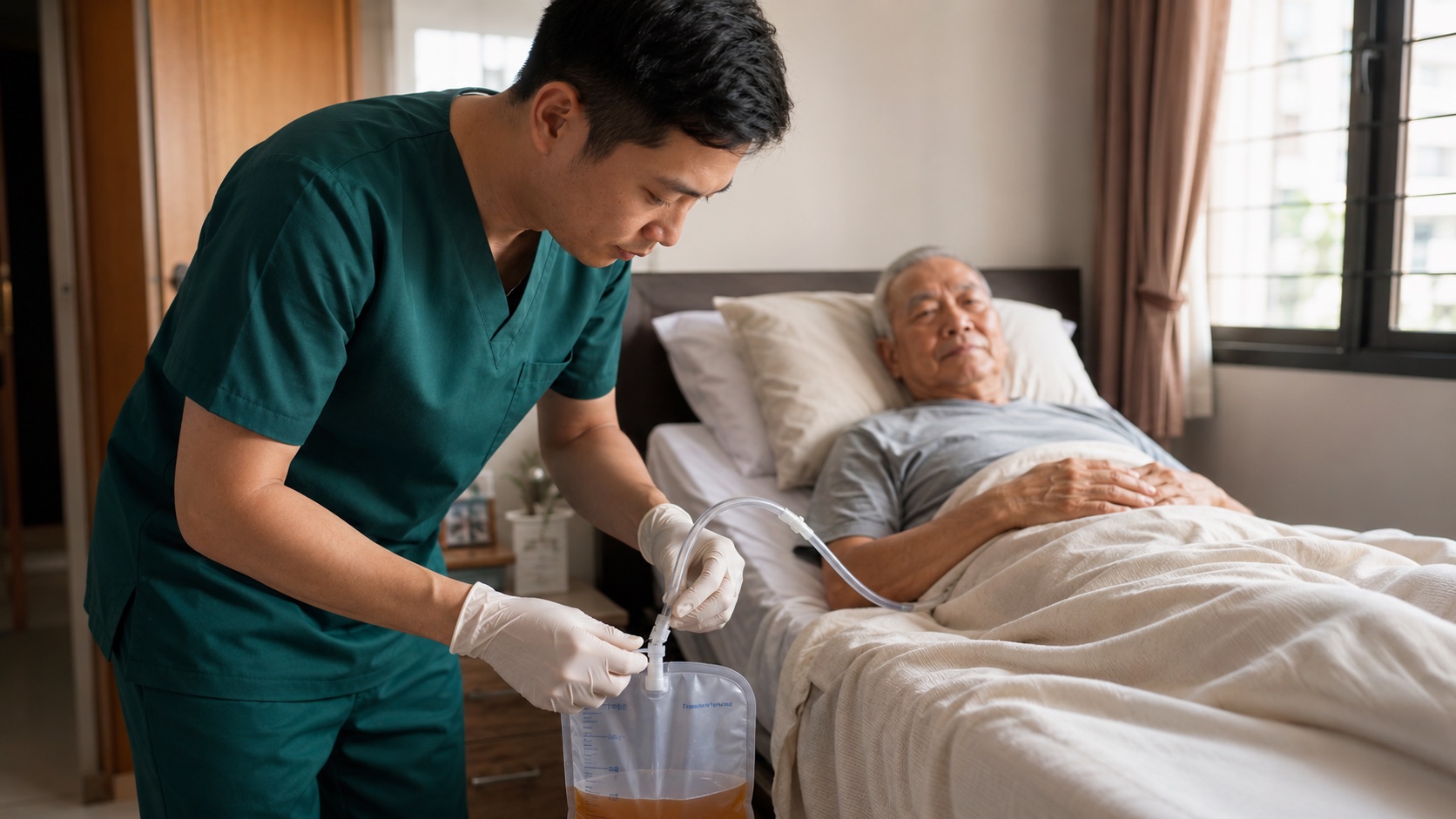
A male urinary catheter change at home in Singapore costs from S$160 per visit with us — consumables at cost. This is a procedure a number of home providers decline to perform; our SNB-registered nurses do it at home, remove the old indwelling catheter, insert a fresh one, and confirm it is draining before leaving a written summary for the patient's doctor.
 homenurse.sg
SNB-registered nurses
Every visit is by a nurse registered with the Singapore Nursing Board.
Real prices, published
Flat per-visit fees with consumables at cost — no minimum on per-visit care.
A summary for your doctor
You get a written visit summary to share with the patient's own doctor.
What it costs
typically S$160–220 per visit for the nurse's time. Consumables are billed separately at cost — no markup. The fee also covers travel within mainland Singapore and a written summary for the patient's doctor. See the full pricing list.
Surcharges, where they apply:
- Same-day / urgent (booked within 24 hours): +S$60
- Off-island / remote zones (Sentosa, Jurong Island, Tuas South): +S$55
- Visits beyond 60 minutes: +S$60 per additional 30 minutes
- Nursing fee (typical)
- S$160–220
- Consumables (at cost)
- S$41–52
Consumables: catheter, drainage bag, anaesthetic gel and sterile gloves — at our supplier cost, no markup.
See itemised consumables
- Catheterisation SetS$10
- Urinary CatheterS$5
- Urine BagS$4
- Urine Bag HangerS$1.80
- Lignocaine Gel (cathgel)S$16
- Gloves Sterile (7)S$2.50
- Sodium Chloride 0.9% 20mlS$1.20
- Single use Syringe (10ml)S$0.60
Your exact all-in price — including any urgent or off-island fee — is confirmed before we visit. See the full pricing.
What happens during the visit
- The nurse confirms the patient's details and checks the catheter site.
- The existing catheter is removed gently.
- A new sterile catheter is inserted using an appropriate technique and the balloon inflated.
- Drainage is confirmed and the catheter and bag secured.
- A written visit summary is left for the patient's own doctor.
Who needs this
Men with a long-term indwelling urinary catheter that needs routine replacement, including after prostate surgery or with urinary retention.
How often: Usually changed every 4–6 weeks.
Subsidies you may be eligible for
Eligible Singapore Citizens and PRs may qualify for AIC-subsidised home nursing and the Home Caregiving Grant. See home nursing subsidies for who qualifies and how to apply.
When to call a doctor
- The catheter cannot be passed, or no urine drains after the change
- Significant bleeding or severe pain
- Fever, chills, or cloudy, foul-smelling urine
For urgent or severe symptoms, call 995 or go to the nearest A&E.
How it works
- 1
Call or enquire
Tell us what care is needed and where. We confirm the visit and the price up front.
- 2
A nurse visits
An SNB-registered nurse comes to your home at a time that suits you and carries out the care.
- 3
Written summary
You get a written summary to share with the patient's doctor, and we plan any repeat visits.
Frequently asked questions
Why do some providers not do male catheter changes at home?
How much does a male catheter change at home in Singapore cost?
Read our care guide: Male Catheter Care at Home: Safe and Comfortable.
Arranging this care after hospital discharge?
We provide prompt home nursing transition for patients discharged from public and private hospitals across Singapore:
Available across Singapore neighbourhoods
Nurses visit homes islandwide. Popular planning areas include: