Stitch and Staple Removal at Home
Taking stitches out is simple — as long as the wound is ready and it's done cleanly. Here's what a good nurse checks before, during, and after.
 homenurse.sg
General information, not a substitute for personal medical advice. For urgent symptoms, call 995.
What good care looks like
Good home nursing is more than completing a task. For stitch and staple removal, it means a trained nurse who works cleanly and gently, checks how the patient is doing, keeps the family informed, and writes down what they found so the patient's doctor stays in the loop. The best sign of good care is that nothing is a surprise — the family knows what was done, what to watch for, and when the next visit is.
Is the wound ready?
The first job isn't removal — it's checking the wound has healed enough to hold together without the stitches. A good nurse looks at whether the edges have knitted, follows the timing the surgeon advised, and won't pull stitches out early just because a date has arrived. If the wound isn't ready, that's a conversation with the doctor, not a rushed removal.
Clean, one at a time
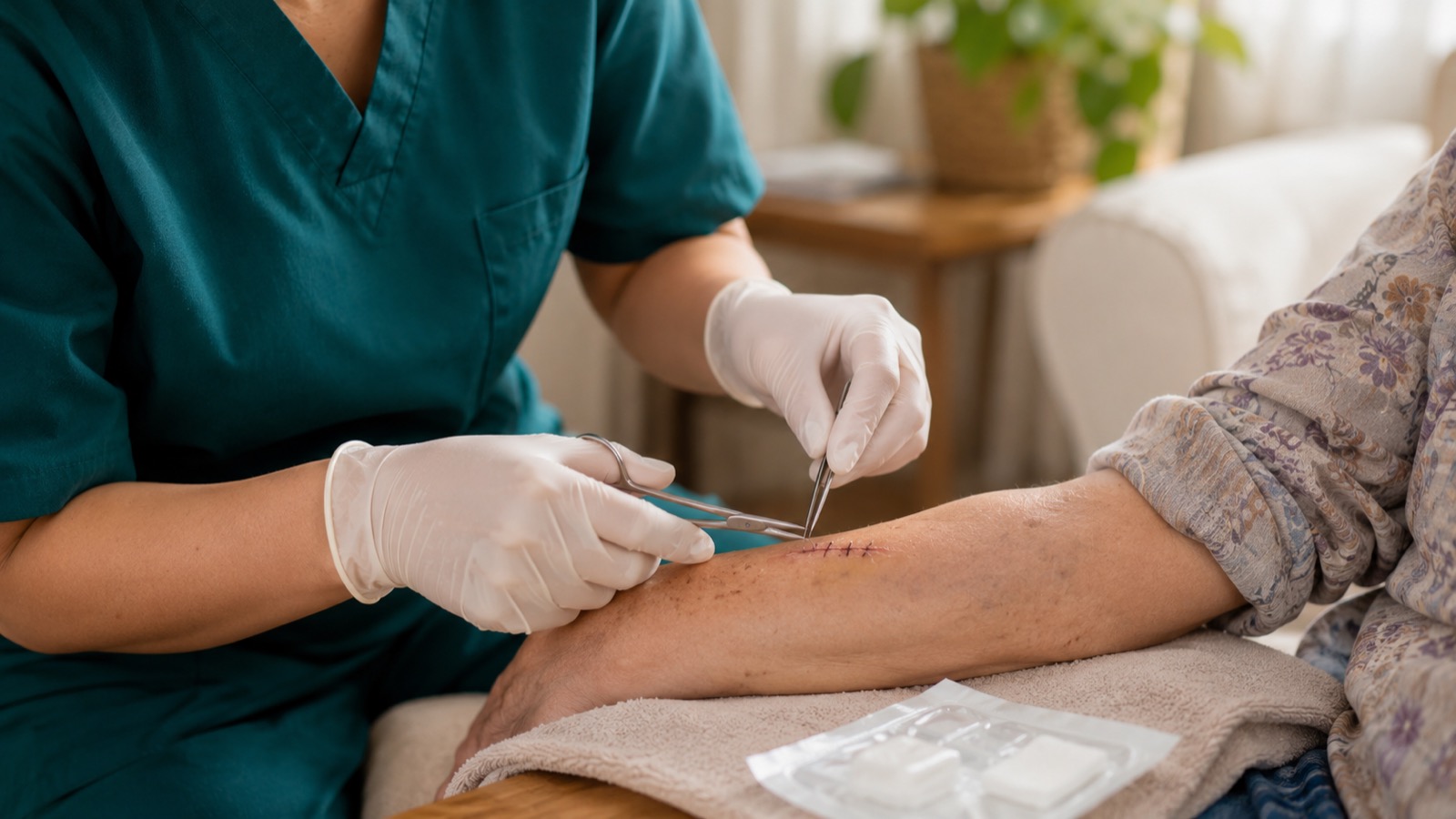
Removal itself should be clean and unhurried. A good nurse works with a clean field, lifts and cuts each stitch or staple so no exposed part is dragged through the skin, and takes them out one at a time while checking the wound stays closed.
Aftercare and scars
Care doesn't end when the last stitch is out. Good care means cleaning and, if needed, redressing the site, and giving simple advice on keeping the scar clean, protected from the sun, and moisturised as it matures.
When to call for help
Call for help if:
- The wound opens or gapes after the stitches come out
- There's increasing redness, warmth, swelling, or pus
- There's fever, or the wound becomes more painful instead of less
One thing a home nurse should not do: cosmetic stitches
Stitches after cosmetic or aesthetic surgery are a different job, and a living room is the wrong place for it. Fine sutures on a face are placed to disappear, and taking them out with ordinary instruments under ordinary light risks the one thing the patient paid to avoid. Some are not even meant to come out — in non-incision double eyelid surgery a non-absorbable thread anchors the eyelid muscle to the skin, and removing the wrong one can lose the crease. Working millimetres from the cornea belongs in a clinic with proper positioning and magnification.
So good care here includes knowing the limit. We remove stitches and staples at home after general, orthopaedic, obstetric and day surgery — abdominal and limb wounds, surgical staples, drain sites. For anything cosmetic we point you to a doctor in clinic instead, and you contact the clinic directly.
When cosmetic stitches need to come out
Timing matters more than most people expect. Left too long, fine sutures leave marks of their own; removed too early, the wound can open. These are the windows surgeons generally work to — your own surgeon's instruction always overrides them.
| Procedure | Usual removal |
|---|---|
| Double eyelid, non-incision | About 3 days |
| Double eyelid, partial incision | 4–5 days |
| Upper or lower blepharoplasty, full incision | 5–7 days |
| Rhinoplasty and facial procedures | 5–7 days (splint usually 5–6 days) |
| Body — abdominoplasty, breast, liposuction | 7–14 days |
Common questions
Can a nurse remove my stitches at home after cosmetic surgery?
No. HomeNurse.sg does not remove stitches after cosmetic or aesthetic surgery at home. Fine cosmetic sutures need magnification and a clinical setting, some eyelid sutures are meant to stay in, and removal near the eye is not appropriate for a home visit. We refer these cases to a doctor in clinic instead.
I had surgery in Korea and returned to Singapore with stitches in. What should I do?
See a doctor in a clinic rather than arranging a home nurse visit. Korean clinics usually expect international patients to remain 1 to 2 weeks so the surgeon can remove the stitches and check healing. If you have already flown home, treat it as time-sensitive: non-incision double eyelid sutures come out at about 3 days, partial incision at 4 to 5 days, full incision at 5 to 7 days.
When should stitches be removed after cosmetic surgery?
Non-incision double eyelid at about 3 days, partial incision at 4 to 5 days, full incision blepharoplasty at 5 to 7 days, rhinoplasty and facial procedures at 5 to 7 days, and body procedures such as abdominoplasty, breast surgery and liposuction at 7 to 14 days. Your own surgeon's instruction always takes precedence.
What stitch removal does HomeNurse.sg do at home?
Stitches and staples after general, orthopaedic, obstetric and day surgery at body sites, including abdominal and limb wounds, surgical staples and drain sites. Each visit includes a wound check and a written summary for your doctor, from S$120 per visit.